Living in Korea as a Foreigner: Your First 30 Days, In the Right Order
Your flight lands. You have an apartment, a job, and a phone that stops working the moment you leave the airport Wi-Fi. Now what?
Here is the part almost nobody tells you: the tasks of your first month in Korea are locked to each other. Do them in the wrong order and you will sit in a chair at a bank branch, be told "you need your ARC first," and lose two weeks you did not plan to lose.
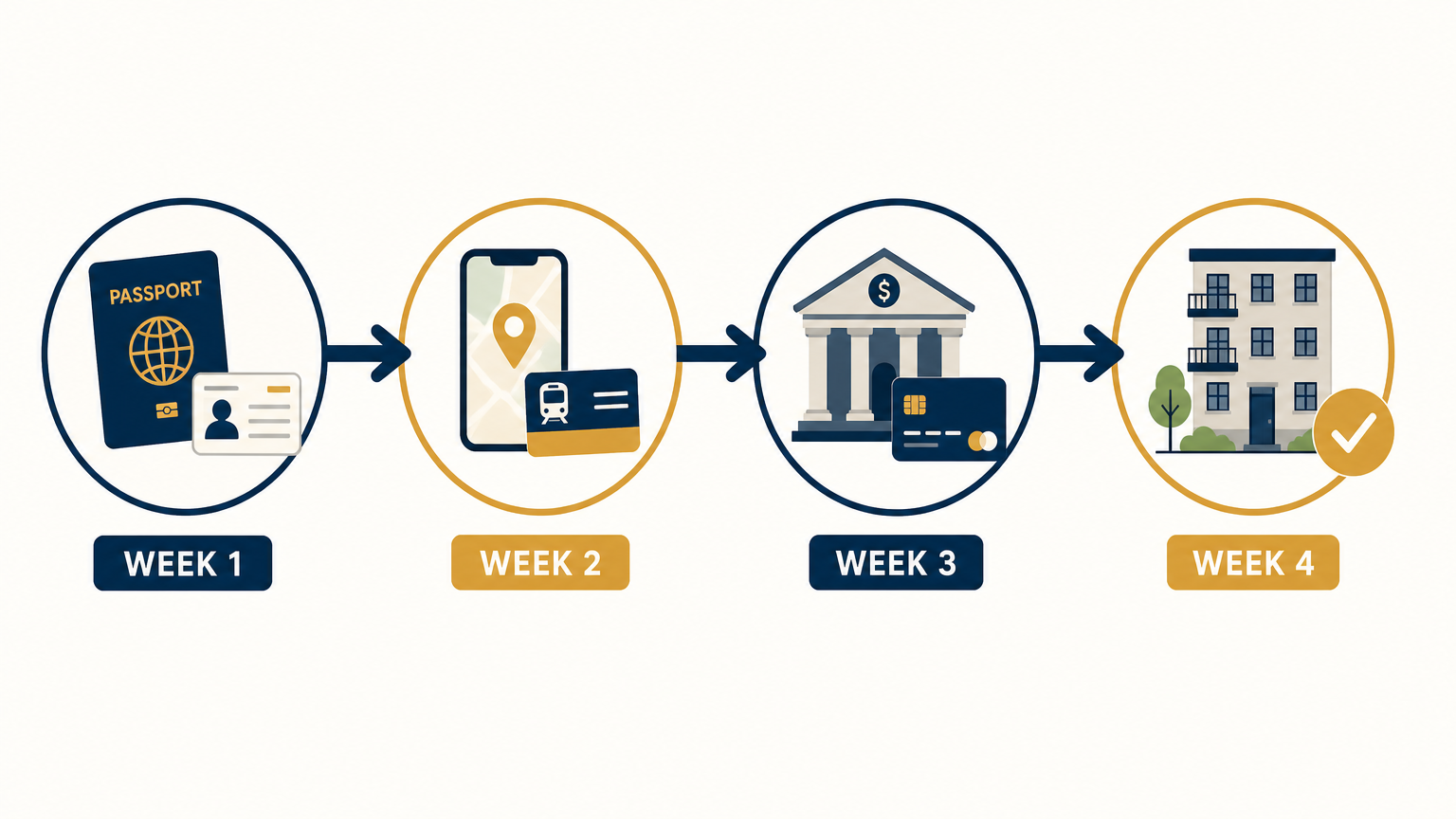
This guide lays out those first 30 days in the order that actually works.
The Real Problem Isn't Language. It's Sequence.
Most guides about living in Korea as a foreigner tell you what to do: get your Alien Registration Card, open a bank account, get a phone plan. All true. All useless without the missing piece.
The missing piece is that these are not a checklist. They are a chain. Each one unlocks the next.
Miss that, and you will discover it the hard way — standing at a counter, being politely turned away.
The Dependency Map
This is the single most useful table you will read this month.
| What you want | What it needs first | What happens without it |
|---|---|---|
| Alien Registration Card (ARC) | Passport + visa + local address | Nothing else on this list works properly |
| Full bank account | ARC (most banks) | Limited "foreigner account" only, or refused |
| Postpaid phone plan | ARC + bank account | Prepaid SIM only, at higher cost |
| National Health Insurance | ARC | You pay full price at clinics |
| Apartment lease in your name | ARC + bank account | You depend on your employer or an agent |
Read the middle column again. Everything traces back to one card.
Week 1: Get the Chain Started
Apply for your ARC. This is the only real priority.
You must apply within 90 days of entry, but treating that as a deadline is the mistake. Treat it as day one. Processing typically takes a few weeks, and everything else is waiting on it.
-
Book your appointment through HiKorea, the government's official immigration portal. Walk-ins are often not accepted
-
Bring: passport, visa documents, passport photo, application fee, and proof of address
-
Your employer usually provides the address documentation — ask for it before you fly
While you wait, get a prepaid SIM. It works on your passport alone. It costs more per month, but it keeps you reachable and it does not block anything later.
Week 2: Set Up the Basics That Don't Need the Card
You are in a waiting period. Use it.
-
Learn two apps: Naver Map or KakaoMap for navigation (Google Maps is limited in Korea for driving directions), and Papago for translation. These two solve most daily friction
-
Get a T-money transit card at any convenience store. Cash purchase, no ID required. It works on subways, buses, and many taxis nationwide
-
Locate your district office (구청) and the nearest immigration office. You will visit both
-
Ask your employer one question: are they enrolling you in National Health Insurance, or are you doing it yourself? The answer changes what you do in Week 4
Week 3: The Card Arrives — Move Immediately
The day your ARC is in your hand, the chain unlocks. Do these in this order:
-
Open a bank account. Bring your ARC and passport. Some branches are far more comfortable with foreign customers than others — branches near universities and business districts tend to have English-capable staff
-
Convert your phone to a postpaid plan. With an ARC and a Korean bank account, you get normal pricing and normal contracts
-
Register for a Korean payment app if your bank offers one. This is what most delivery, transit, and shopping apps expect
Doing these on the same week matters. Each one takes an hour; waiting between them takes days.
Week 4: Settle In
-
Confirm your health insurance status. If you are employed, your company usually handles enrollment. If you are freelance or self-employed, you register yourself at the National Health Insurance Service
-
Set up utilities and internet in your name if your lease requires it
-
Register your address change at the district office if you have moved since your ARC application — this is a legal requirement, not a formality
By the end of this month, living in Korea stops feeling like paperwork and starts feeling like a place you actually live.
What This Costs, Roughly
Budgets vary by city and lifestyle, but the setup costs of your first month are fairly predictable:
| Item | Typical range |
|---|---|
| ARC application fee | ₩30,000 |
| Prepaid SIM (first month) | ₩30,000–₩50,000 |
| Postpaid phone plan (monthly) | ₩30,000–₩70,000 |
| T-money card | ₩3,000 + top-up |
| Bank account opening | Free |
The expensive part of your first month is not the fees. It is the weeks lost to doing things out of order.
FAQ
Can I get a phone plan without an ARC?
You can get a prepaid SIM with only your passport, and you should — do it on day one. A postpaid contract plan generally requires an ARC and a Korean bank account.
Bank account first, or phone first?
Bank account. Most postpaid phone contracts want a Korean account for automatic payment. Both wait on your ARC.
How long does an ARC actually take?
Plan for a few weeks between application and pickup. It varies by office and season — immigration offices are busiest at the start of academic semesters, so apply as early as you can.
Which banks are easiest for foreigners?
Rather than choosing by brand, choose by branch. Branches in areas with many international residents — near universities, in business districts, in global centers — are far more likely to have English-speaking staff and experience with foreign documentation.
What if something goes wrong and I need help in English?
The Seoul Global Center supports foreign residents with administrative issues. For medical emergencies, call 119. For immigration questions, HiKorea is the official channel.
You Don't Have to Figure This Out Alone
Every foreigner living in Korea has a version of this story — the week they lost, the counter they were turned away from, the thing nobody told them.
The difference between a rough first month and a smooth one is usually just one person who already went through it. That is the real shortcut to living in Korea as a foreigner: not a better checklist, but someone who already made the mistakes.
That is what JungKorea is for. Real people who arrived before you, sharing what actually worked — from which branch opened their account to which app finally made deliveries work. If you are about to start living in Korea as a foreigner, you do not have to start from zero.
👉 [Join JungKorea — Free] | Your guide to life in Korea, in English.